_edited.png)


ACCREDITATIONS


Clients
Training Service Description
Course Duration
1 Day
Training Delivery Method
Classroom (Instructor-Led) or Online (Instructor-Led)
Instructors Languages
English / Arabic / Urdu / Hindi / Pashto
Certification Provider
Tamkene Saudi Training Center - Approved by TVTC (Technical and Vocational Training Corporation)
Certificate Validity
2 Years (Extendable with additional training hours)
Course Average Passing Rate
96%
Competency Assessment Criteria
Practical Assessment and Knowledge Assessment
Post Training Reporting
Post Training Report(s) + Candidate(s) Training Evaluation Forms
Training Design Methodology
ADDIE Training Design Methodology
Certificate of Successful Completion
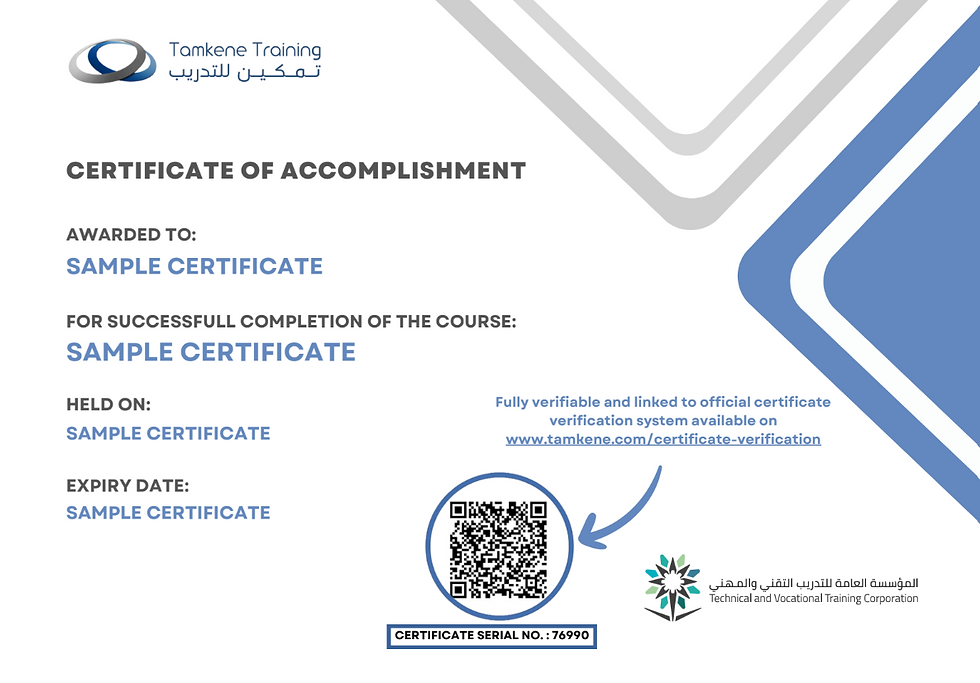
Certification is provided upon successful completion. The certificate can be verified through a QR-Code system.
Course Overview
This intensive HSE Leadership training course provides participants with essential knowledge and practical skills required for developing and sustaining effective health, safety, and environmental management systems through leadership excellence. The course covers fundamental HSE leadership principles along with advanced strategies for building safety culture, engaging workforce, and driving continuous improvement in organizational HSE performance.
Participants will learn to apply industry best practices and international standards including ISO 45001 for occupational health and safety management systems, ISO 14001 for environmental management systems, and OSHA Voluntary Protection Programs (VPP) for safety and health management. This course combines theoretical concepts with practical applications and real-world case studies to ensure participants gain valuable skills applicable to their professional environment while emphasizing visible leadership commitment, employee engagement, and organizational accountability. The training focuses on developing competent leaders who can inspire safety excellence, influence positive behaviors, and create sustainable HSE cultures within their organizations.
Key Learning Objectives
Understand fundamental HSE leadership principles and responsibilities
Develop effective safety culture and organizational commitment
Implement visible leadership behaviors and engagement strategies
Apply risk-based thinking and decision-making processes
Lead incident investigation and corrective action implementation
Establish performance metrics and continuous improvement systems
Communicate HSE expectations effectively across all organizational levels
Integrate HSE management with business operations and strategic objectives
Course Outline
1. Introduction to HSE Leadership
HSE leadership fundamentals including (leadership versus management distinction, moral and business case for safety, legal obligations, organizational accountability, leadership impact on performance)
International standards framework including (ISO 45001 management system requirements, ISO 14001 environmental principles, OSHA VPP criteria, integration opportunities)
Leadership roles and responsibilities including (executive commitment, management accountability, supervisor duties, worker participation, contractor oversight)
HSE business integration including (strategic alignment, operational excellence, competitive advantage, stakeholder expectations, sustainability objectives)
2. Building Safety Culture
Safety culture components including (shared values and beliefs, behavioral norms, leadership commitment, employee engagement, continuous learning)
Culture maturity assessment including (reactive stage, dependent stage, independent stage, interdependent stage, cultural indicators)
Transformational leadership approaches including (vision setting, inspiration and motivation, intellectual stimulation, individualized consideration, change management)
Employee engagement strategies including (safety committees, suggestion systems, recognition programs, empowerment initiatives, two-way communication)
3. Visible Leadership and Engagement
Visible felt leadership behaviors including (workplace presence, safety conversations, observation participation, barrier removal, recognition delivery)
Leadership walkarounds and inspections including (planning effective tours, asking powerful questions, active listening techniques, immediate corrective actions, follow-up commitments)
Safety dialogue techniques including (open-ended questioning, non-punitive approach, behavioral observation feedback, coaching conversations, peer-to-peer influence)
Leading by example including (personal PPE compliance, procedure adherence, stop work authority demonstration, near-miss reporting, continuous improvement participation)
4. Risk-Based Leadership and Decision Making
Risk assessment integration per ISO 45001 including (hazard identification processes, risk evaluation methods, control hierarchy application, residual risk acceptance, change management)
Risk-based decision making including (balancing safety and production, resource allocation priorities, precautionary principle application, uncertainty management, stakeholder consideration)
Critical risk management including (fatality prevention programs, critical control identification, barrier management, major accident hazards, bow-tie analysis)
Operational discipline including (procedure compliance expectations, deviation management, permit-to-work oversight, quality control, verification systems)
5. Incident Leadership and Learning
Incident investigation leadership per OSHA 1904 including (investigation team formation, resource allocation, external expertise engagement, corrective action approval, accountability enforcement)
Root cause analysis oversight including (methodology selection, investigation quality assurance, systemic issue identification, human factors consideration, organizational learning)
Corrective action implementation including (action plan development, responsibility assignment, timeline establishment, effectiveness verification, closure confirmation)
Learning organization development including (lessons learned dissemination, knowledge management, best practice sharing, cross-functional collaboration, continuous improvement culture)
6. Performance Measurement and Continuous Improvement
Leading and lagging indicators per ANSI Z10 including (proactive metrics selection, behavioral observations, safety training hours, near-miss reporting rates, audit completion)
Performance monitoring systems including (dashboard development, trend analysis, benchmarking practices, target setting, progress tracking)
Management review processes per ISO 45001 including (performance evaluation frequency, data analysis, improvement opportunities, resource needs, strategic alignment)
Continuous improvement methodologies including (Plan-Do-Check-Act cycle, gap analysis, corrective and preventive actions, management of change, innovation encouragement)
7. HSE Communication and Influence
Communication strategy development including (message clarity, audience segmentation, channel selection, frequency determination, feedback mechanisms)
Influencing safety behaviors including (positive reinforcement, consequence management, peer influence, social norms, behavioral economics principles)
Conflict resolution and difficult conversations including (addressing non-compliance, performance management, competing priorities, resource constraints, organizational resistance)
Crisis communication leadership including (emergency response coordination, stakeholder notification, media relations, transparency principles, post-crisis recovery)
1. Introduction to HSE Leadership
HSE leadership fundamentals including (leadership versus management distinction, moral and business case for safety, legal obligations, organizational accountability, leadership impact on performance)
International standards framework including (ISO 45001 management system requirements, ISO 14001 environmental principles, OSHA VPP criteria, integration opportunities)
Leadership roles and responsibilities including (executive commitment, management accountability, supervisor duties, worker participation, contractor oversight)
HSE business integration including (strategic alignment, operational excellence, competitive advantage, stakeholder expectations, sustainability objectives)
2. Building Safety Culture
Safety culture components including (shared values and beliefs, behavioral norms, leadership commitment, employee engagement, continuous learning)
Culture maturity assessment including (reactive stage, dependent stage, independent stage, interdependent stage, cultural indicators)
Transformational leadership approaches including (vision setting, inspiration and motivation, intellectual stimulation, individualized consideration, change management)
Employee engagement strategies including (safety committees, suggestion systems, recognition programs, empowerment initiatives, two-way communication)
3. Visible Leadership and Engagement
Visible felt leadership behaviors including (workplace presence, safety conversations, observation participation, barrier removal, recognition delivery)
Leadership walkarounds and inspections including (planning effective tours, asking powerful questions, active listening techniques, immediate corrective actions, follow-up commitments)
Safety dialogue techniques including (open-ended questioning, non-punitive approach, behavioral observation feedback, coaching conversations, peer-to-peer influence)
Leading by example including (personal PPE compliance, procedure adherence, stop work authority demonstration, near-miss reporting, continuous improvement participation)
4. Risk-Based Leadership and Decision Making
Risk assessment integration per ISO 45001 including (hazard identification processes, risk evaluation methods, control hierarchy application, residual risk acceptance, change management)
Risk-based decision making including (balancing safety and production, resource allocation priorities, precautionary principle application, uncertainty management, stakeholder consideration)
Critical risk management including (fatality prevention programs, critical control identification, barrier management, major accident hazards, bow-tie analysis)
Operational discipline including (procedure compliance expectations, deviation management, permit-to-work oversight, quality control, verification systems)
5. Incident Leadership and Learning
Incident investigation leadership per OSHA 1904 including (investigation team formation, resource allocation, external expertise engagement, corrective action approval, accountability enforcement)
Root cause analysis oversight including (methodology selection, investigation quality assurance, systemic issue identification, human factors consideration, organizational learning)
Corrective action implementation including (action plan development, responsibility assignment, timeline establishment, effectiveness verification, closure confirmation)
Learning organization development including (lessons learned dissemination, knowledge management, best practice sharing, cross-functional collaboration, continuous improvement culture)
6. Performance Measurement and Continuous Improvement
Leading and lagging indicators per ANSI Z10 including (proactive metrics selection, behavioral observations, safety training hours, near-miss reporting rates, audit completion)
Performance monitoring systems including (dashboard development, trend analysis, benchmarking practices, target setting, progress tracking)
Management review processes per ISO 45001 including (performance evaluation frequency, data analysis, improvement opportunities, resource needs, strategic alignment)
Continuous improvement methodologies including (Plan-Do-Check-Act cycle, gap analysis, corrective and preventive actions, management of change, innovation encouragement)
7. HSE Communication and Influence
Communication strategy development including (message clarity, audience segmentation, channel selection, frequency determination, feedback mechanisms)
Influencing safety behaviors including (positive reinforcement, consequence management, peer influence, social norms, behavioral economics principles)
Conflict resolution and difficult conversations including (addressing non-compliance, performance management, competing priorities, resource constraints, organizational resistance)
Crisis communication leadership including (emergency response coordination, stakeholder notification, media relations, transparency principles, post-crisis recovery)
Group Exercises
Safety culture transformation planning including (assessing current culture maturity, developing leadership action plan for culture improvement, establishing engagement strategies and accountability measures)
Crisis leadership scenario including (managing simulated major incident requiring executive decision-making, stakeholder communication, resource mobilization, and organizational resilience demonstration)
Gained Core Technical Skills
HSE leadership fundamentals per ISO 45001 and ISO 14001 including (management system requirements, leadership and commitment obligations, policy establishment, organizational role assignment, resource allocation, performance evaluation)
Safety culture development including (culture maturity assessment, transformational leadership application, employee engagement strategy implementation, behavioral influence techniques, recognition program design)
Visible leadership practices including (effective workplace presence, safety dialogue facilitation, observation and feedback delivery, barrier removal processes, leading by example behaviors)
Risk-based decision making per ISO 45001 including (risk assessment integration, control hierarchy application, critical risk management, operational discipline enforcement, change management oversight)
Incident investigation leadership per OSHA 1904 including (investigation resource allocation, root cause analysis quality assurance, corrective action approval and tracking, organizational learning promotion, accountability enforcement)
Performance management per ANSI Z10 including (leading and lagging indicator selection, performance monitoring system establishment, trend analysis interpretation, management review facilitation, continuous improvement methodology application)
HSE communication and influence including (strategic communication planning, behavioral influence techniques, conflict resolution approaches, crisis communication leadership, stakeholder engagement methods)
Services Geographical Coverage
In Tamkene Training Center or On-Site: Covering All Saudi Arabia Cities (Dammam - Khobar - Dhahran - Jubail - Qatif - Saihat - Safwa - Ras Tanura - Al Ahsa - Abqaiq - Nairiyah - Hafr Al Batin - Haradh - Khurais - Tanajib - Ras AlKhair - Jafurah - Fadhili - Wasit - Manifa - Berri - Shaybah - Hawiyah - Uthmaniyah - Riyadh - Shaqra - Dhurma - Wasea - AlKharj - Al Majmaah - Sudair - Zulfi - Qassim - Buraydah - Unaizah - Jeddah - Makkah - AlArous - Taif - Rabigh - Madinah - Yanbu - AlUla - Tabuk - NEOM - Oxagon - The Line - Waad AlShamal - Arar - Umluj - Hail - Sakaka - Abha - Khamis Mushait - Najran - Jazan - AlBahah - Jouf - Any City or location in Saudi Arabia)
Targeted Audience
Senior Executives establishing HSE strategic direction
Operations Managers responsible for HSE performance
HSE Managers leading safety programs and initiatives
Department Supervisors with safety accountability
Team Leaders influencing frontline safety behaviors
Project Managers integrating HSE into project execution
Facility Managers overseeing workplace safety
Human Resources Personnel supporting safety culture development
Training Coordinators developing leadership capabilities
Practical Assessment
Leadership walkabout simulation including (conducting mock workplace inspection, engaging employees in safety conversations, identifying improvement opportunities)
Safety meeting facilitation including (leading effective toolbox talk, addressing employee concerns, communicating HSE expectations clearly)
Incident response exercise including (demonstrating leadership actions during simulated workplace incident, coordinating investigation resources, communicating with stakeholders)
Knowledge Assessment
Leadership principles evaluation including (identifying effective versus ineffective leadership behaviors in safety scenarios, matching leadership actions to culture maturity stages)
Risk-based decision scenarios including (analyzing complex operational decisions requiring safety-production balance, determining appropriate risk acceptance criteria)
Performance metric application including (selecting appropriate leading and lagging indicators for specific organizational contexts, interpreting performance dashboard data)
Standard compliance knowledge including (matching ISO 45001 and ISO 14001 requirements to leadership responsibilities, identifying OSHA VPP criteria applications)
Why Choose This Course
Comprehensive HSE leadership framework aligned with international standards
Practical tools for immediate workplace application
Focus on culture transformation and sustainable performance
Integration of leadership theory with real-world HSE challenges
Development of visible leadership and engagement skills
Performance measurement and continuous improvement strategies
Crisis leadership and decision-making capabilities
Note: This course outline, including specific topics, modules, and duration, can be customized based on the specific needs and requirements of the client.


.jpg)
Recommended Courses

_edited.jpg)

Suggested Questions

.png)
The training I received from Tamkene was truly exceptional.
Dalal AlSaeed

.png)
Choosing Tamkene for our professional development was a game-changer.
Wafi AlZayer

.png)
Tamkene delivered quality training with a strong focus on standards. The organization and delivery exceeded our expectations.
Saad AlMisehal
Testimonial