_edited.png)


ACCREDITATIONS


Clients


.webp)
.webp)
RESULTS-ORITNTED Training Description
Course Duration
1 Day
Training Delivery Method
Classroom (Instructor-Led) or Online (Instructor-Led)
Instructors Languages
English / Arabic / Urdu / Hindi / Pashto
Certification Provider
Tamkene Saudi Training Center - Approved by TVTC (Technical and Vocational Training Corporation)
Certificate Validity
2 Years (Extendable with additional training hours)
Course Average Passing Rate
98%
Competency Assessment Criteria
Practical Assessment and Knowledge Assessment
Post Training Reporting
Post Training Report(s) + Candidate(s) Training Evaluation Forms
Training Design Methodology
ADDIE Training Design Methodology
Certificate of Successful Completion
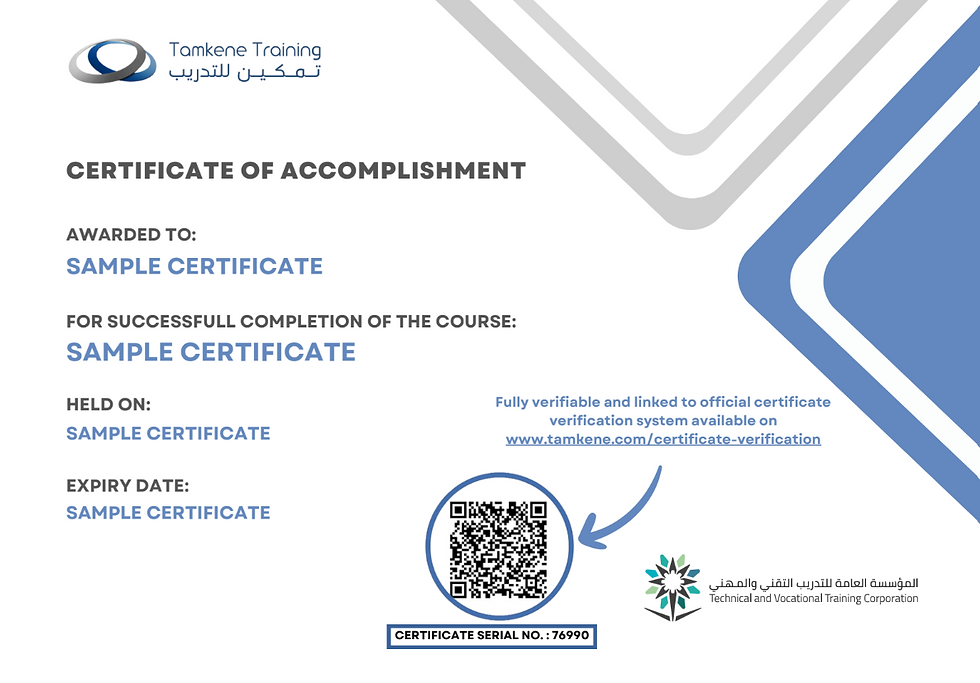
Certification is provided upon successful completion. The certificate can be verified through a QR-Code system.
Course Overview
Respiratory hazards represent one of the most serious occupational health risks across industries where personnel are exposed to airborne contaminants, toxic vapors, particulates, and oxygen-deficient atmospheres. Respirator fit testing is a mandatory regulatory requirement under OSHA 29 CFR 1910.134 – Respiratory Protection Standard, supported by CSA Z94.4 – Selection, Use, and Care of Respirators and NIOSH 42 CFR Part 84 – Approval of Respiratory Protective Devices, ensuring that every respirator worn in the workplace achieves a verified facial seal adequate to protect the wearer against identified hazards.
This course equips organizations with the practical knowledge and procedural competency required to conduct, administer, and document a compliant respirator fit testing program. Participants will work through the full fit testing process — from medical evaluation prerequisites and respirator selection criteria, through the execution of OSHA-accepted Qualitative Fit Test (QLFT) and Quantitative Fit Test (QNFT) protocols — while developing the skills to apply Root Cause Analysis (RCA) to fit test failures, maintain equipment quality assurance, and integrate fit testing into a broader Written Respiratory Protection Program (RPP) that meets regulatory audit requirements.
Key Learning Objectives
Understand the regulatory framework governing respiratory protection including OSHA 29 CFR 1910.134, CSA Z94.4, and NIOSH 42 CFR Part 84
Differentiate between qualitative and quantitative fit testing methods and determine their appropriate application based on respirator type and protection level
Apply respirator selection criteria based on hazard classification, Assigned Protection Factors (APFs), and workplace exposure conditions
Execute qualitative and quantitative fit test protocols accurately and under supervision in full compliance with OSHA 29 CFR 1910.134 Appendix A
Identify the mandatory components of a Written Respiratory Protection Program (RPP) and fulfill fit test administrator documentation obligations
Apply Root Cause Analysis (RCA) to diagnose recurring fit test failures and implement structured corrective actions including refit procedures and alternative respirator selection
Maintain fit testing equipment, calibration records, and quality assurance systems in alignment with regulatory and program requirements
Course Outline
1. Introduction to Respiratory Protection and Regulatory Framework
Overview of respiratory hazards and health consequences in the workplace including (airborne particulates, toxic vapors and gases, biological aerosols, oxygen-deficient atmospheres, and carcinogenic dusts)
Applicable regulatory standards and legal obligations including (OSHA 29 CFR 1910.134 – Respiratory Protection Standard, CSA Z94.4 – Selection, Use, and Care of Respirators, NIOSH 42 CFR Part 84, and ACGIH Threshold Limit Values (TLVs))
The hierarchy of controls and the position of respiratory protection including (elimination, substitution, engineering controls, administrative controls, and PPE as the final layer of defense)
Written Respiratory Protection Program (RPP) mandatory elements including (program administrator designation, employee training requirements, medical evaluation procedures, fit testing records, and annual program review obligations)
Assigned Protection Factors (APFs) and their regulatory basis including (half-face filtering facepiece APF of 10, elastomeric half-face APF of 10, full-face respirator APF of 50, and powered air-purifying respirator APF values per OSHA 29 CFR 1910.134 Table 1)
2. Respirator Types, Selection, and Medical Evaluation Prerequisites
Classification of respiratory protective devices and their protective mechanisms including (air-purifying respirators, supplied-air respirators, self-contained breathing apparatus, and escape-only devices)
Respirator selection criteria based on hazard characterization including (contaminant type, concentration relative to occupational exposure limits, IDLH environment identification, and compatibility with additional PPE)
Medical evaluation requirements prior to fit testing including (completion of the OSHA medical questionnaire, physician or licensed healthcare professional (PLHCP) clearance, and medical contraindications to tight-fitting facepiece use)
NIOSH-approved cartridge and filter selection including (P100 particulate filters, organic vapor cartridges, acid gas cartridges, combination cartridges, and end-of-service-life indicator requirements)
Facial geometry and fit considerations including (impact of facial hair, scars, dental appliances, and pronounced facial features on respirator seal integrity, and the selection process for alternative respirator models or sizes)
3. Qualitative Fit Testing (QLFT) Methods and Protocols
Principles and regulatory scope of qualitative fit testing including (subjective sensory detection basis, applicability limited to negative-pressure air-purifying respirators with APF ≤10 per OSHA 29 CFR 1910.134 Appendix A, and inherent limitations)
OSHA-accepted QLFT agent protocols including (Isoamyl Acetate protocol, Saccharin Solution Aerosol protocol, Bitrex Denatonium Benzoate Aerosol protocol, and Irritant Smoke protocol)
Sensitivity screening procedures prior to QLFT execution including (saccharin taste threshold screening, Bitrex taste threshold screening, isoamyl acetate smell threshold screening, and required actions upon screening failure)
Step-by-step QLFT execution under supervision including (correct respirator donning and adjustment, test hood or enclosure positioning, performance of all seven prescribed exercise sequences, and pass/fail determination criteria)
QLFT documentation and recordkeeping requirements including (fit test record form completion, employee identification and respirator make/model/size recording, test date and administrator details, and record retention obligations)
4. Quantitative Fit Testing (QNFT) Methods and Protocols
Principles of quantitative fit testing and fit factor measurement including (ambient aerosol condensation nuclei counter method, controlled negative pressure method, and generated aerosol method per OSHA 29 CFR 1910.134 Appendix A)
Instrumentation setup and operation including (PortaCount ambient particle counting principles, pre-test calibration verification procedures, sampling probe placement on the respirator facepiece, and particle concentration ratio calculation)
Minimum acceptable fit factors per OSHA 29 CFR 1910.134 including (fit factor ≥100 for half-face respirators, fit factor ≥500 for full-face respirators, and pass/fail interpretation for powered air-purifying respirators)
Executing the seven standard exercise protocols during QNFT under supervision including (normal breathing, deep breathing, head side-to-side, head up and down, talking, grimace, and bending over per OSHA Appendix A sequencing requirements)
Quantitative test failure diagnosis using Root Cause Analysis (RCA) including (probe leak identification, instrument contamination causes, inappropriate respirator sizing, and face seal integrity failures due to facial geometry)
5. Fit Test Administration, Documentation, and Quality Assurance
Roles and responsibilities of the designated fit test administrator including (pre-test preparation, equipment readiness verification, clear worker communication, and impartial pass/fail determination)
Fit testing frequency requirements and repeat testing triggers including (mandatory annual retesting under OSHA 29 CFR 1910.134, physical condition changes, change in respirator model or size, and worker-reported seal discomfort)
Equipment calibration and maintenance procedures including (daily PortaCount bump testing and calibration, saccharin and Bitrex solution preparation and shelf-life management, and test hood and enclosure inspection protocols)
Quality assurance practices for fit testing program integrity including (inter-tester reliability verification, audit trail maintenance, non-conformance documentation, and corrective and preventive action (CAPA) implementation)
Integration of fit testing records into the Written Respiratory Protection Program including (OSHA recordkeeping cross-reference requirements, employee medical record linkage, and management reporting and compliance reporting structures)
6. HSE in Respiratory Protection Operations
Occupational health risk assessment in respiratory protection contexts including (hazard identification methodologies, airborne exposure monitoring strategies, and comparison of measured concentrations against OSHA Permissible Exposure Limits (PELs) and ACGIH TLVs)
Physiological considerations during respirator use including (CO₂ accumulation in tight-fitting facepieces, heat stress management in high-ambient-temperature environments across the Middle East, and increased work of breathing under physical exertion)
Emergency response and confined space respiratory protection requirements including (SCBA requirements under OSHA 29 CFR 1910.146 – Permit-Required Confined Spaces, airline respirator protocols in rescue operations, and emergency egress respirator procedures)
Regulatory compliance and audit readiness for respiratory protection programs including (internal audit checklists aligned with OSHA 29 CFR 1910.134, management of change for new respiratory hazard introductions, and preparation for regulatory inspection)
Worker rights and employer obligations under respiratory protection law including (right to medical evaluation at no cost, right to refuse respirator use when medically contraindicated, and employer obligation to provide NIOSH-approved equipment free of charge)
7. Quality and Continuous Improvement in Respiratory Protection Programs
Quality management principles applied to fit testing programs including (Plan-Do-Check-Act (PDCA) cycle application, program performance metric selection, and benchmarking against ANSI/AIHA Z88.2 – Practices for Respiratory Protection)
Root Cause Analysis (RCA) application to recurring fit test failures including (fishbone diagram construction, 5-Why analysis for repeated non-conformances, and systematic corrective action planning with defined accountability and timelines)
Fit test failure trend analysis and program improvement including (population-level data collection, identification of high-failure-rate respirator models, and evidence-based procurement recommendations)
Fit test administrator competency and ongoing development including (administrator qualification standards, refresher training intervals, and maintaining current knowledge of evolving OSHA and NIOSH guidance)
Continual improvement frameworks for respiratory protection programs including (annual program review structure per OSHA 29 CFR 1910.134, employee feedback integration mechanisms, and alignment with broader occupational health management systems)
1. Introduction to Respiratory Protection and Regulatory Framework
Overview of respiratory hazards and health consequences in the workplace including (airborne particulates, toxic vapors and gases, biological aerosols, oxygen-deficient atmospheres, and carcinogenic dusts)
Applicable regulatory standards and legal obligations including (OSHA 29 CFR 1910.134 – Respiratory Protection Standard, CSA Z94.4 – Selection, Use, and Care of Respirators, NIOSH 42 CFR Part 84, and ACGIH Threshold Limit Values (TLVs))
The hierarchy of controls and the position of respiratory protection including (elimination, substitution, engineering controls, administrative controls, and PPE as the final layer of defense)
Written Respiratory Protection Program (RPP) mandatory elements including (program administrator designation, employee training requirements, medical evaluation procedures, fit testing records, and annual program review obligations)
Assigned Protection Factors (APFs) and their regulatory basis including (half-face filtering facepiece APF of 10, elastomeric half-face APF of 10, full-face respirator APF of 50, and powered air-purifying respirator APF values per OSHA 29 CFR 1910.134 Table 1)
2. Respirator Types, Selection, and Medical Evaluation Prerequisites
Classification of respiratory protective devices and their protective mechanisms including (air-purifying respirators, supplied-air respirators, self-contained breathing apparatus, and escape-only devices)
Respirator selection criteria based on hazard characterization including (contaminant type, concentration relative to occupational exposure limits, IDLH environment identification, and compatibility with additional PPE)
Medical evaluation requirements prior to fit testing including (completion of the OSHA medical questionnaire, physician or licensed healthcare professional (PLHCP) clearance, and medical contraindications to tight-fitting facepiece use)
NIOSH-approved cartridge and filter selection including (P100 particulate filters, organic vapor cartridges, acid gas cartridges, combination cartridges, and end-of-service-life indicator requirements)
Facial geometry and fit considerations including (impact of facial hair, scars, dental appliances, and pronounced facial features on respirator seal integrity, and the selection process for alternative respirator models or sizes)
3. Qualitative Fit Testing (QLFT) Methods and Protocols
Principles and regulatory scope of qualitative fit testing including (subjective sensory detection basis, applicability limited to negative-pressure air-purifying respirators with APF ≤10 per OSHA 29 CFR 1910.134 Appendix A, and inherent limitations)
OSHA-accepted QLFT agent protocols including (Isoamyl Acetate protocol, Saccharin Solution Aerosol protocol, Bitrex Denatonium Benzoate Aerosol protocol, and Irritant Smoke protocol)
Sensitivity screening procedures prior to QLFT execution including (saccharin taste threshold screening, Bitrex taste threshold screening, isoamyl acetate smell threshold screening, and required actions upon screening failure)
Step-by-step QLFT execution under supervision including (correct respirator donning and adjustment, test hood or enclosure positioning, performance of all seven prescribed exercise sequences, and pass/fail determination criteria)
QLFT documentation and recordkeeping requirements including (fit test record form completion, employee identification and respirator make/model/size recording, test date and administrator details, and record retention obligations)
4. Quantitative Fit Testing (QNFT) Methods and Protocols
Principles of quantitative fit testing and fit factor measurement including (ambient aerosol condensation nuclei counter method, controlled negative pressure method, and generated aerosol method per OSHA 29 CFR 1910.134 Appendix A)
Instrumentation setup and operation including (PortaCount ambient particle counting principles, pre-test calibration verification procedures, sampling probe placement on the respirator facepiece, and particle concentration ratio calculation)
Minimum acceptable fit factors per OSHA 29 CFR 1910.134 including (fit factor ≥100 for half-face respirators, fit factor ≥500 for full-face respirators, and pass/fail interpretation for powered air-purifying respirators)
Executing the seven standard exercise protocols during QNFT under supervision including (normal breathing, deep breathing, head side-to-side, head up and down, talking, grimace, and bending over per OSHA Appendix A sequencing requirements)
Quantitative test failure diagnosis using Root Cause Analysis (RCA) including (probe leak identification, instrument contamination causes, inappropriate respirator sizing, and face seal integrity failures due to facial geometry)
5. Fit Test Administration, Documentation, and Quality Assurance
Roles and responsibilities of the designated fit test administrator including (pre-test preparation, equipment readiness verification, clear worker communication, and impartial pass/fail determination)
Fit testing frequency requirements and repeat testing triggers including (mandatory annual retesting under OSHA 29 CFR 1910.134, physical condition changes, change in respirator model or size, and worker-reported seal discomfort)
Equipment calibration and maintenance procedures including (daily PortaCount bump testing and calibration, saccharin and Bitrex solution preparation and shelf-life management, and test hood and enclosure inspection protocols)
Quality assurance practices for fit testing program integrity including (inter-tester reliability verification, audit trail maintenance, non-conformance documentation, and corrective and preventive action (CAPA) implementation)
Integration of fit testing records into the Written Respiratory Protection Program including (OSHA recordkeeping cross-reference requirements, employee medical record linkage, and management reporting and compliance reporting structures)
6. HSE in Respiratory Protection Operations
Occupational health risk assessment in respiratory protection contexts including (hazard identification methodologies, airborne exposure monitoring strategies, and comparison of measured concentrations against OSHA Permissible Exposure Limits (PELs) and ACGIH TLVs)
Physiological considerations during respirator use including (CO₂ accumulation in tight-fitting facepieces, heat stress management in high-ambient-temperature environments across the Middle East, and increased work of breathing under physical exertion)
Emergency response and confined space respiratory protection requirements including (SCBA requirements under OSHA 29 CFR 1910.146 – Permit-Required Confined Spaces, airline respirator protocols in rescue operations, and emergency egress respirator procedures)
Regulatory compliance and audit readiness for respiratory protection programs including (internal audit checklists aligned with OSHA 29 CFR 1910.134, management of change for new respiratory hazard introductions, and preparation for regulatory inspection)
Worker rights and employer obligations under respiratory protection law including (right to medical evaluation at no cost, right to refuse respirator use when medically contraindicated, and employer obligation to provide NIOSH-approved equipment free of charge)
7. Quality and Continuous Improvement in Respiratory Protection Programs
Quality management principles applied to fit testing programs including (Plan-Do-Check-Act (PDCA) cycle application, program performance metric selection, and benchmarking against ANSI/AIHA Z88.2 – Practices for Respiratory Protection)
Root Cause Analysis (RCA) application to recurring fit test failures including (fishbone diagram construction, 5-Why analysis for repeated non-conformances, and systematic corrective action planning with defined accountability and timelines)
Fit test failure trend analysis and program improvement including (population-level data collection, identification of high-failure-rate respirator models, and evidence-based procurement recommendations)
Fit test administrator competency and ongoing development including (administrator qualification standards, refresher training intervals, and maintaining current knowledge of evolving OSHA and NIOSH guidance)
Continual improvement frameworks for respiratory protection programs including (annual program review structure per OSHA 29 CFR 1910.134, employee feedback integration mechanisms, and alignment with broader occupational health management systems)
Group Exercises
QLFT practice session including (conducting sensitivity screening, performing fit test, executing test exercises, determining results)
QNFT practice session including (equipment setup, probe placement, test execution, fit factor interpretation)
Gained Core Technical Skills
Competency in conducting both qualitative and quantitative respirator fit tests in full compliance with OSHA 29 CFR 1910.134 and CSA Z94.4
Proficiency in respirator selection based on hazard assessment outcomes, APF requirements, and NIOSH approval classifications
Capability to operate, calibrate, and maintain fit testing equipment including PortaCount instrumentation and qualitative test solutions and enclosures
Ability to develop, review, and maintain compliant Written Respiratory Protection Program documentation aligned with OSHA recordkeeping requirements
Application of Root Cause Analysis (RCA) and Plan-Do-Check-Act (PDCA) frameworks to diagnose fit test failures and drive measurable, sustained program improvement
Services Geographical Coverage
In Tamkene Training Center or at our client's facility (On-Site), Covering All Saudi Arabia Cities and Locations:
Targeted Audience
HSE officers and occupational health personnel responsible for administering organizational respiratory protection programs
Safety supervisors and team leaders overseeing personnel working in environments with confirmed or potential airborne hazard exposure
Industrial hygienists and occupational health practitioners managing workplace exposure monitoring and control programs
Maintenance, operations, and technical personnel who are required to wear respirators as part of their routine job scope
HR and training personnel responsible for coordinating and documenting mandatory health and safety training compliance across the organization
Procurement and facility management personnel involved in evaluating, selecting, and sourcing respiratory protective equipment
Practical Assessment
Qualitative fit test execution under supervision including (performing Bitrex or saccharin sensitivity screening, correctly donning and adjusting the selected respirator, conducting all seven exercise sequences, and accurately determining pass/fail per OSHA 29 CFR 1910.134 Appendix A)
Quantitative fit test execution under supervision including (setting up and verifying PortaCount calibration, positioning the sampling probe correctly, running the full exercise protocol, and interpreting the fit factor output against applicable minimum thresholds)
Fit test record completion and documentation exercise including (accurately populating a fit test record form with all OSHA-required fields, identifying documentation deficiencies in a provided sample record, and preparing a structured corrective action entry for a failed result)
Knowledge Assessment
Technical quizzes on fit testing concepts including (multiple-choice questions on OSHA requirements, matching exercise for test methods, protocol identification)
Scenario-based assessments including (analyzing fit testing situations, troubleshooting problems, determining appropriate actions)
Protocol exercises including (identifying proper test procedures, recognizing protocol violations, ensuring compliance)
Documentation evaluation including (reviewing test records, identifying missing information, ensuring regulatory compliance)
Why Choose This Course
Fully aligned with OSHA 29 CFR 1910.134, CSA Z94.4, and NIOSH 42 CFR Part 84
Covers qualitative and quantitative fit testing with structured hands-on execution under supervision
Addresses respiratory protection challenges specific to high-temperature industrial environments across the Middle East
Builds internal organizational capability to administer, document, and audit a compliant Respiratory Protection Program
Integrates Root Cause Analysis (RCA) and continuous improvement frameworks for long-term program sustainability
Note: This course outline, including specific topics, modules, and duration, can be customized based on the specific needs and requirements of the client.


.jpg)
Recommended Courses

.png)

Suggested Questions

.png)
The training I received from Tamkene was truly exceptional.
Dalal AlSaeed

.png)
Choosing Tamkene for our professional development was a game-changer.
Wafi AlZayer

.png)
Tamkene delivered quality training with a strong focus on standards. The organization and delivery exceeded our expectations.
Saad AlMisehal
Testimonial